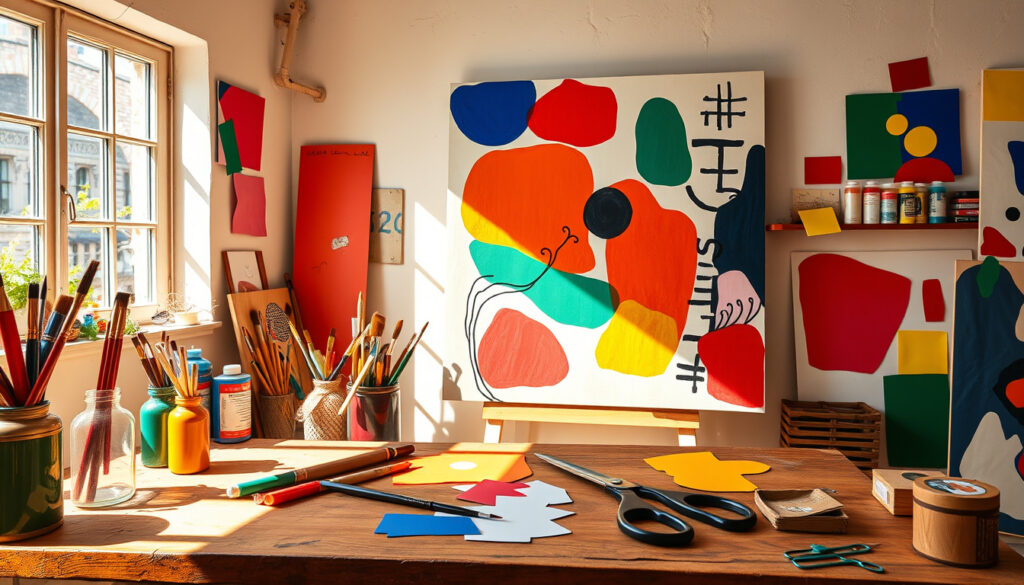
Henri Matisse – Master of Color and Modern Art
Henri Matisse, the French artist who led the Fauvist movement, transformed modern art with his revolutionary use of colour. His career, spanning nearly six and a half decades, produced paintings, sculptures, prints, and the iconic paper cut-outs of his final years. This article explores his life, his distinctive art style, his most famous works, and the enduring legacy of a master who painted not objects, but the emotions they inspired.
When and Where Was Henri Matisse Born?
- Matisse’s use of color was revolutionary, often employing unnatural hues to express emotion rather than realism.
- Despite being a Fauvist leader, Matisse’s later years were defined by his paper cut-outs, a medium born from physical limitations.
- He produced over 800 works, including paintings, prints, sculptures, and the famous Jazz series.
- His painting Goldfish is often interpreted as a meditation on perception, reflection, and the act of looking.
- Matisse is regarded, alongside Picasso and Duchamp, as a defining figure in early 20th-century plastic arts.
- He began his artistic journey late, turning to painting at age 21 while recovering from an illness.
| Key Fact | Details |
|---|---|
| Full name | Henri Émile Benoît Matisse |
| Initial training | Law, turned to art after an appendicitis attack in 1890 |
| Movement founded | Co-founded Fauvism with André Derain in 1905 |
| Major collections | Musée Matisse (Nice), Tate (London), MoMA (New York), Hermitage (St. Petersburg) |
| Famous works | The Dance (1909), The Red Studio (1911), Goldfish (1912), The Snail (1953) |
| Award | Grand Prix at the 1905 Salon d’Automne |
Early Life and Education
Henri Matisse was born on 31 December 1869 in Le Cateau, Picardy, France. Originally trained as a lawyer, he only began studying art at age 21, starting to paint during a convalescence from an operation, according to the Tate. He moved to Paris in 1891 to study art in a traditional, academic style, focusing on still-life and landscapes.
Move to Nice and Later Years
In 1917, Matisse relocated to Cimiez, a suburb of Nice on the French Riviera, settling there permanently in 1921. His work during the 1920s gained critical acclaim as he upheld the classical tradition in French painting. This era, known as his early Nice period, featured luxurious, exotic interiors filled with southern light, bright colours, and decorative patterns, often depicting the female figure or an odalisque.
Death and Legacy
Matisse died on 3 November 1954, in Nice. He is commonly regarded, alongside Pablo Picasso and Marcel Duchamp, as one of the three artists who defined the revolutionary developments in the plastic arts of the early 20th century, as noted by the Tate.
What Is Henri Matisse’s Art Style?
The Fauvist Movement and Matisse’s Role
Between 1900 and 1905, Matisse’s intense colourism brought him notoriety as one of the Fauves (French for “wild beasts”), a name he helped define alongside artists like André Derain. The Fauvist movement emphasized the use of bright, unnatural colours to convey emotional expression rather than realistic depiction, according to biographical sources. Notable works from this period include Woman with a Hat (1905), The Green Line (1905), and The Joy of Life (1906).
Matisse’s Use of Color and Draughtsmanship
Matisse is renowned for his fluid and original drawing style. His mastery of expressive colour and drawing won him recognition as a leading figure in modern art. He famously stated, “I do not paint a woman, I paint a picture,” emphasizing his focus on form and colour over realistic representation.
Evolution of Style: From Fauvism to Cut-Outs
After 1906, Matisse developed a rigorous style emphasizing flattened forms and decorative patterns, moving away from the intense Fauvist palette. In his final years, when ill health (including abdominal cancer diagnosed in 1941) prevented him from painting, he created a significant body of work using cut paper collage, a technique he described as “painting with scissors.”
Matisse’s physical limitations due to health issues did not stop his creativity; they redirected it. These cut-outs, featuring brilliantly colored paper arranged with an unfailing eye for design, became some of his most famous works, including The Snail (1953) and Swimming Pool (1952).
What Are Some Famous Artworks by Henri Matisse?
Goldfish (1912) – A Study of Color and Reflection
Matisse’s painting Goldfish is often interpreted as a meditation on perception, reflection, and the act of looking. While widely seen as a study of color and reflection, some art historians debate whether it also contains autobiographical or spiritual symbolism. It is a subject within his broader corpus, not a distinct “goldfish painting” title.
Still Life Works: Everyday Objects Transformed
Matisse’s vast oeuvre covered landscape, still life, portraiture, interior views, and the female figure. His still life works, like The Red Studio (1911), transformed everyday objects through his unique lens of form and colour, as documented by the Museum of Modern Art.
The Cut-Outs: A Revolutionary Late Style
Matisse’s cut-outs are considered a pinnacle of simplification and pure form. Key examples include The Snail (1953) and Swimming Pool (1952), a series of human figures cut from bright blue paper. He also created designs for stained glass, tapestries, book plates, and ceramics.
Iconic Works: The Dance, The Red Studio, and Others
Other notable works include Nu bleu (1907), La Danse (1909), and L’Atelier Rouge (1911). These works are held in major collections worldwide, including the Musée Matisse in Nice, the Hermitage in St. Petersburg, and the Museum of Modern Art in New York.
Did Henri Matisse Create Prints?
Matisse as a Printmaker: Techniques and Themes
Matisse was not only a painter but also a master draughtsman, printmaker, and sculptor. He began experimenting with printmaking in the early 1900s, focusing seriously on etching in the 1910s. He was especially involved in lithography, creating over 100 original lithographs for the Mourlot studio and black-and-white illustrations for books.
Notable Print Series: Jazz and Others
The Jazz series is among his most famous print works, created using the cut-out technique and later reproduced as pochoir prints. This series exemplifies his mastery of colour and form in a new medium.
Where to See Matisse Prints Today
Original prints by Matisse can be purchased through major auction houses like Christie’s or specialized art dealers. Works on paper often appear in sales, and provenance should always be verified. The Tate in London holds a significant collection of his prints and sculptures.
His printmaking output includes etching, lithography, and pochoir. The Jazz series, completed in 1947, remains one of the most celebrated limited-edition artist books of the 20th century.
How Do You Pronounce Henri Matisse?
Correct French Pronunciation
His name is pronounced in French as [ɑ̃ʁi emil bənwa matis] (roughly “Ah-nree eh-meel be-nwah Maa-teez”), as noted by the Tate and Wikipedia.
Common Mispronunciations
English speakers often pronounce the “t” in Matisse, while the French pronunciation omits it, making it sound like “Maa-teez” without a hard “t” sound at the end.
What Are the Most Famous Henri Matisse Quotes?
Quotes on Color and Art
“Color was not given to us in order that we should imitate Nature. It was given to us so that we can express our own emotions.”
Henri Matisse, as quoted in various biographies
“I do not literally paint that table, but the emotion it produces upon me.”
Henri Matisse, Notes of a Painter (1908)
Quotes on Creativity and Life
“There is nothing more difficult for a truly creative painter than to paint a rose, because before he can do so he has first to forget all the roses that were ever painted.”
Henri Matisse, attributed
A Timeline of Henri Matisse’s Life
- 1869 – Born in Le Cateau-Cambrésis, northern France
- 1890 – Began painting while recovering from illness
- 1892 – Moved to Paris to study art at the Académie Julian
- 1905 – Exhibited at the Salon d’Automne, giving birth to Fauvism
- 1917 – Moved to Nice, where he would produce most of his later work
- 1941 – Diagnosed with cancer; began working on paper cut-outs
- 1952 – Opened the Chapelle du Rosaire in Vence, his final major project
- 1954 – Died in Nice at age 84
What Do We Know for Certain About Matisse and What Remains Unclear?
| Established Information | Information That Remains Unclear |
|---|---|
| Matisse’s exact birth date: 31 December 1869. All major sources agree. | Interpretation of Goldfish: While widely seen as a study of color and reflection, some art historians debate whether it contains autobiographical or spiritual symbolism. |
| Well-documented rivalry and mutual respect with Picasso. | Causes of his move to Nice: Health reasons are often cited, but some suggest he simply preferred the light. No single definitive reason is recorded. |
Matisse in Context: Fauvism, Modernism, and Legacy
Henri Matisse emerged at a time of radical change in the art world. Alongside Derain and Vlaminck, he pioneered Fauvism, a movement that liberated color from its descriptive role. The 1905 Salon d’Automne shocked visitors with its “wild beast” paintings.
Matisse’s work spans decades of experimentation. After Fauvism, he embraced a more refined, decorative style, often featuring odalisques and interiors. His later cut-outs are considered a pinnacle of simplification and pure form.
His influence extends beyond painting to printmaking, sculpture, and even modern design. Matisse’s emphasis on emotion through colour and line continues to inspire contemporary artists.
Where to Learn More and Explore
Henri Matisse’s legacy endures as a master of colour, form, and design, fundamentally altering the course of modern art. For those seeking to explore further, the Musée Matisse in Nice holds the most comprehensive collection of his works. His essay Notes of a Painter offers a direct window into his artistic philosophy. Major works can be viewed at the Tate in London and the Museum of Modern Art in New York, where his revolutionary cut-outs continue to captivate audiences.
Frequently Asked Questions About Henri Matisse
How can I buy original Henri Matisse prints?
Original prints by Matisse can be purchased through major auction houses (Christie’s, Sotheby’s) or specialized art dealers. Works on paper often appear in sales. Always verify provenance.
Are there any Henri Matisse works at the Tate?
Yes, the Tate holds a significant collection of Matisse paintings, prints, and sculptures, including The Snail and The Red Studio.
What is Henri Matisse’s most famous painting?
Among his most recognized works are The Dance, The Red Studio, Goldfish, and The Snail. His cut-out The Snail is especially iconic.
What art movement is Henri Matisse associated with?
He is best known as a founding figure of Fauvism, but his later work also aligns with Modernism and abstract tendencies.
Who was Henri Matisse influenced by?
Early influences include the Impressionists (especially Cézanne), the Post-Impressionists (Gauguin, Van Gogh), and the symbolism of Paul Signac.
What is the significance of Matisse’s cut-outs?
Created when ill health prevented him from painting, the cut-outs represent a revolutionary late style, emphasizing pure colour and form through cut paper.
Did Matisse and Picasso know each other?
Yes, they had a well-documented rivalry and mutual respect, acknowledging each other’s influence on their work.
More related posts
 6 Nations Fixtures 2025 – Complete Schedule, Results & Winner
 Caoimhin Kelleher – Irish Goalkeeper Profile, Stats, and Transfer
 Work from Home Jobs UK – No Experience Remote Roles
 Jeffrey Epstein Prince Andrew – Scandal Arrest and Timeline
 Labubu Have a Seat – Complete UK Collector’s Guide 2025
 Antique Brass Door Handles – Complete Buyer’s Guide 2025
 Jason Momoa Movies and TV Shows – Full List in Order
 What Do Hedgehogs Eat – Complete Guide to Wild and Pet Diets