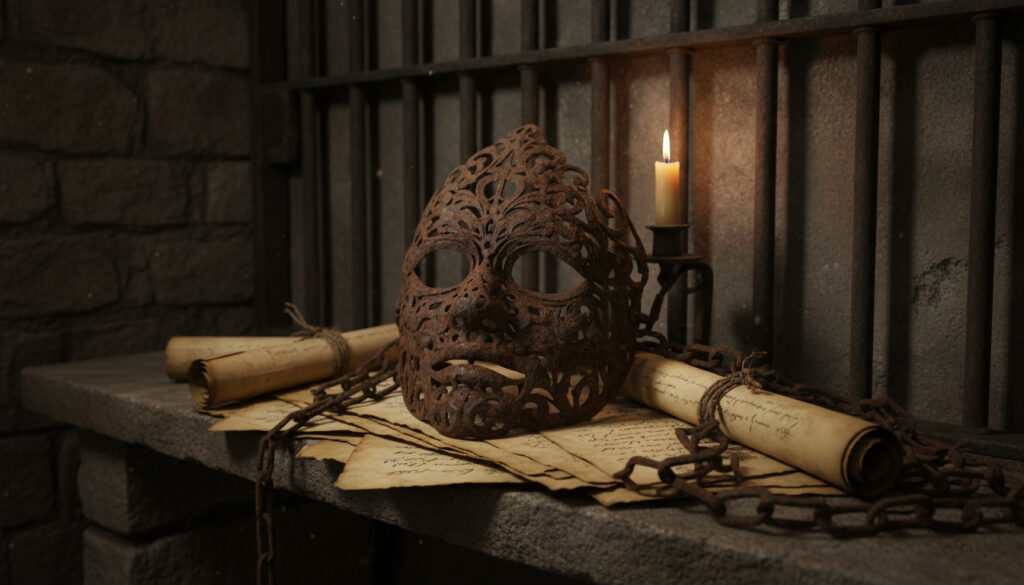
The Man in the Iron Mask – True History and Identity Facts
For thirty-four years, a prisoner known only by whisper and legend moved between the most secure fortresses of Louis XIV’s France. Arrested in 1669 and dead by 1703, he entered history as the Man in the Iron Mask, though the mask itself was likely velvet and his true identity remains one of the most contested mysteries of the Ancien Régime.
Historical records confirm the existence of this captive, held in strict isolation under the watch of Bénigne Dauvergne de Saint-Mars. Yet the reason for his detention, the nature of his crime, and even his real name—possibly Eustache Dauger, possibly someone else entirely—continue to resist definitive proof despite three centuries of archival research.
Who Was the Man in the Iron Mask?
Unknown prisoner, most likely Eustache Dauger, a valet
Imprisoned 1669–1703 with face covered during transfers
Arrest circa 1669; died 19 November 1703
State secret; knowledge of sensitive information, possibly involving Cardinal Mazarin
- Primary identity: Archives point to Eustache Dauger, a valet arrested under orders from war minister Louvois.
- Mask material: Contemporary accounts describe black velvet, not iron, worn only during prison transfers.
- Isolation protocol: Saint-Mars enforced strict silence; the prisoner was forbidden to speak to others or show his face.
- Primary evidence: Surviving letters between Louvois and Saint-Mars confirm the name “Dauger” and handling instructions.
- Cell sanitation: After the prisoner’s death, his Bastille cell was immediately scrubbed to erase all traces.
- Literary distortion: Alexandre Dumas and Voltaire transformed the valet into a royal twin, obscuring the historical record.
- Epistemological status: Existence is certain; motivation and exact identity remain unverified.
| Fact | Details |
|---|---|
| Arrest | ~1669, ordered by War Minister Louvois [source] |
| Name in records | Eustache Dauger (or Dauger de Cavoye, disputed) |
| Prisons held | Pignerol, Exilles, Sainte-Marguerite, Bastille [source] |
| Mask type | Black velvet, used during transfers only [source] |
| Jailer | Bénigne Dauvergne de Saint-Mars |
| Death | 19 November 1703, aged approximately 45 [source] |
| Burial | Saint-Paul Cemetery, Paris (name recorded as “Marchioly”) |
| Cell treatment | Immediately sanitized post-mortem to remove all material traces [source] |
What Are the Main Theories About His Identity?
Historians have proposed several candidates to fill the void behind the mask. Each theory carries distinct evidentiary weight, though none has achieved consensus.
The Valet Eustache Dauger
Archival evidence strongly suggests the prisoner was Eustache Dauger, a valet who may have possessed dangerous knowledge regarding Cardinal Mazarin’s alleged embezzlement from English royalty. Primary correspondence between Louvois and Saint-Mars consistently references this name, describing him as a low-status servant rather than a noble or royal figure. The theory aligns with the rigorous isolation imposed—valets with state secrets posed specific security risks.
The Royal Twin Theory
Voltaire speculated in his 1751 Age of Louis XIV that the mask concealed a face identical to the Sun King’s, proposing the prisoner was Louis XIV’s twin brother, hidden to prevent succession disputes. Alexandre Dumas later dramatized this idea in The Vicomte de Bragelonne, cementing the image of an iron-masked royal in popular imagination. Modern historians dismiss this as pure fiction, noting no documentary evidence supports a hidden twin.
Ercole Antonio Matthioli
Some scholars have identified the prisoner as Ercole Antonio Matthioli, an Italian diplomat betrayed after double-crossing Louis XIV during Treaty of Nijmegen negotiations. However, prison records indicate Matthioli remained at Pignerol when Saint-Mars transferred the masked prisoner to other facilities, effectively ruling him out.
Other Candidates
Additional proposals include General Bulonde (disproven, as he died six years after the prisoner’s arrival), the disgraced finance minister Nicolas Fouquet, and Eustache Dauger de Cavoye—a distinct individual born in 1637 who killed a boy in a brawl. The relationship between Dauger the valet and Dauger de Cavoye remains unclear, though they may be the same person or relatives.
Despite the enduring legend, the mask was constructed of black velvet, not iron. Accounts indicate it was worn only during prison transfers to prevent recognition, not as a permanent facial fixture. Historical sources confirm the material was soft fabric suited for temporary concealment rather than the rigid metal depicted in literature and film.
Why Was He Imprisoned and Forced to Wear a Mask?
State Secrets and Silence
The prisoner appears to have been arrested specifically to prevent the disclosure of sensitive information. Records suggest Dauger served as a valet to high-ranking individuals with access to Cardinal Mazarin’s financial dealings, potentially involving the misappropriation of funds from English royalty. Authorities threatened death if he spoke, and Saint-Mars maintained strict protocols ensuring the prisoner never conversed with guards or other inmates.
The Security Protocol
The velvet mask represented a mobile security measure rather than torture. Applied during transfers between Pignerol, Exilles, Sainte-Marguerite, and the Bastille, it prevented identification by transport staff or observers. This procedural secrecy suggests authorities feared recognition more than they sought to punish the prisoner’s appearance.
Was the Man in the Iron Mask Real or Just a Legend?
The prisoner was unquestionably real. Primary documentation confirms a masked detainee occupied French prisons from 1669 to 1703. However, the narrative surrounding him—particularly the iron mask and royal lineage—stems largely from literary invention.
Alexandre Dumas’s The Man in the Iron Mask (part of The Vicomte de Bragelonne) invented the identical twin narrative to explore themes of legitimacy and power. Historical records describe a valet subjected to administrative secrecy, not a usurped king. Voltaire’s earlier speculation planted the royal seed; Dumas cultivated the myth into canonical fiction.
The most reliable sources are the administrative letters between Louvois and Saint-Mars, analyzed by historians including Sonnino and Wilkinson. These documents confirm the name “Eustache Dauger,” his status as a valet, and restrictions on communication, but offer no definitive “smoking gun” regarding his specific crime or original identity. Incomplete records ensure the mystery persists.
The convergence of real imprisonment with fictional elaboration creates a unique historiographical problem. Moralistic interpretations have historically obscured the mundane administrative reality: a servant held in indefinite detention for possessing dangerous knowledge, transformed by Enlightenment wit and Romantic literature into a symbol of unjust incarceration and hidden royalty.
What Is Known About His Imprisonment and Death?
- 1669: Arrest ordered by Louvois; prisoner identified as Eustache Dauger. Transferred to Pignerol fortress on the France-Italy border.
- 1669–1690s: Detained at Pignerol alongside other political prisoners, though kept in separate, stricter isolation. [source]
- Late 1690s: Transfer to Exilles in the French Alps under Saint-Mars’s custody. [source]
- ~1698: Move to Sainte-Marguerite, an island fortress off Provence, accompanied by heightened secrecy measures.
- 1698: Final transfer to the Bastille in Paris.
- 19 November 1703: Death at the Bastille, recorded under the name “Marchioly.”
- Post-mortem: Immediate scrubbing of his cell to eliminate material traces; burial at Saint-Paul Cemetery. [source]
What Is Established and What Remains Unknown?
| Established Information | Information That Remains Unclear |
|---|---|
| A real prisoner existed under Louis XIV from 1669 to 1703 | Whether Eustache Dauger and Eustache Dauger de Cavoye are the same individual |
| Name recorded in primary sources: Eustache Dauger | The exact crime or secret he possessed |
| Status: Likely a valet or servant | Why he specifically was chosen for such extreme isolation |
| Mask material: Black velvet, not iron | His true origins and family connections |
| Death date: 19 November 1703 | Whether “Marchioly” was his real surname or an alias |
| Jailer throughout: Bénigne Dauvergne de Saint-Mars | The full extent of the Mazarin embezzlement connection |
The Political Context of Louis XIV’s Secret Prisoner
The imprisonment occurred during the apex of Louis XIV’s absolutist rule, a period characterized by the centralization of state power and the suppression of dissent. The use of lettres de cachet allowed the monarchy to detain individuals without trial, creating a legal framework for indefinite administrative imprisonment.
The case of the masked prisoner illustrates the ancien régime‘s capacity for bureaucratic secrecy. Unlike the show trials of heretics or assassins, this detention required no public justification. The prisoner simply disappeared into a chain of fortresses, his identity protected not for his safety but for the state’s. This administrative approach to disappearance reflects the darker mechanics of absolute monarchy, where secrecy served as a tool of governance.
For those interested in how historical mysteries influence modern cultural myths, How Did Mr Krabs Die – SpongeBob Myth Debunked offers a parallel examination of how fictional narratives diverge from factual origins in popular media.
Primary Sources and Contemporary Accounts
The documentary foundation rests upon administrative correspondence rather than memoirs or journalism. The letters exchanged between Louvois, Saint-Mars, and Louis XIV’s cabinet provide the only contemporaneous evidence of the prisoner’s handling.
“The prisoner Dauger is to be held in such a way that he cannot speak to anyone, and he is to be warned that he will be killed if he speaks.”
— Instruction from Louvois to Saint-Mars, 1669 [source]
“He was a young man of average height, with a slightly brown complexion, and his face was covered by a black velvet mask.”
— Contemporary description of transfers, distinguishing fabric from metal [source]
“All the furniture and items in his cell were burned, and the walls were scraped and whitewashed to ensure no trace remained.”
— Post-mortem protocol, Bastille 1703 [source]
The Enduring Legacy of the Masked Prisoner
The Man in the Iron Mask remains a study in the persistence of mystery when state secrecy meets literary imagination. Historical investigation confirms Eustache Dauger existed, suffered thirty-four years of isolated imprisonment, and died in 1703 under circumstances designed to erase his memory. Yet the specific reasons for his fate—whether he knew the secrets of Mazarin’s treasury, bore a resemblance to royalty, or simply possessed inconvenient knowledge—continue to elude definitive resolution.
The case demonstrates how quickly fact fragments under the pressure of narrative. A velvet security mask became iron; a valet became a prince; administrative detention became romantic tragedy. For readers exploring similar intersections of history and fiction, The Last Letter from Your Lover – Book Summary, Ending and Film Guide examines how historical periods are reimagined through modern storytelling.
Frequently Asked Questions
Who was Eustache Dauger?
Eustache Dauger was likely a valet arrested in 1669, identified in primary sources as the prisoner who became known as the Man in the Iron Mask. He may have possessed knowledge of Cardinal Mazarin’s financial dealings.
Is the story of the Man in the Iron Mask true?
The prisoner was real, but the famous “iron” mask and royal twin narrative are fictional inventions by Voltaire and Dumas. The historical figure wore velvet during transfers and was likely a servant, not royalty.
Was the mask actually made of iron?
No. Contemporary accounts describe a mask of black velvet used during prison transfers to prevent recognition. The iron mask is a literary invention from the 18th and 19th centuries.
How many prisons did he stay in?
He was held in four successive prisons: Pignerol (1669–late 1690s), Exilles (late 1690s), Sainte-Marguerite (~1698), and the Bastille (1698–1703).
Who was Saint-Mars?
Bénigne Dauvergne de Saint-Mars served as the prisoner’s jailer throughout his entire 34-year detention, transferring him between fortresses and enforcing strict isolation protocols.
Why was his cell scrubbed after death?
Authorities sanitized the Bastille cell immediately after his death on 19 November 1703, burning furnishings and whitewashing walls to eliminate all material traces of his existence.
What is the difference between Dauger and Dauger de Cavoye?
Eustache Dauger de Cavoye was a real individual born in 1637 who killed a boy in a brawl. Whether he is the same person as the imprisoned Eustache Dauger remains unverified; they may be the same man or distinct relatives.
More related posts
 Best TV Tonight UK – Top Free Primetime Picks
 Man City vs Wolves – 2-0 Win Ends Winless Streak
 John Torode – MasterChef Judge, Career, and Personal Life
 Barcelo Lanzarote Active Resort – Reviews and Facilities Guide
 Knicks vs Lakers Match Player Stats – Box Score, Top Scorers & Recap
 The Last Letter from Your Lover – Book Summary, Ending and Film Guide
 Sydney Sweeney Silver Dress – Variety Power of Women Details
 England Cricket Team Vs India National Cricket Team – Stats Guide