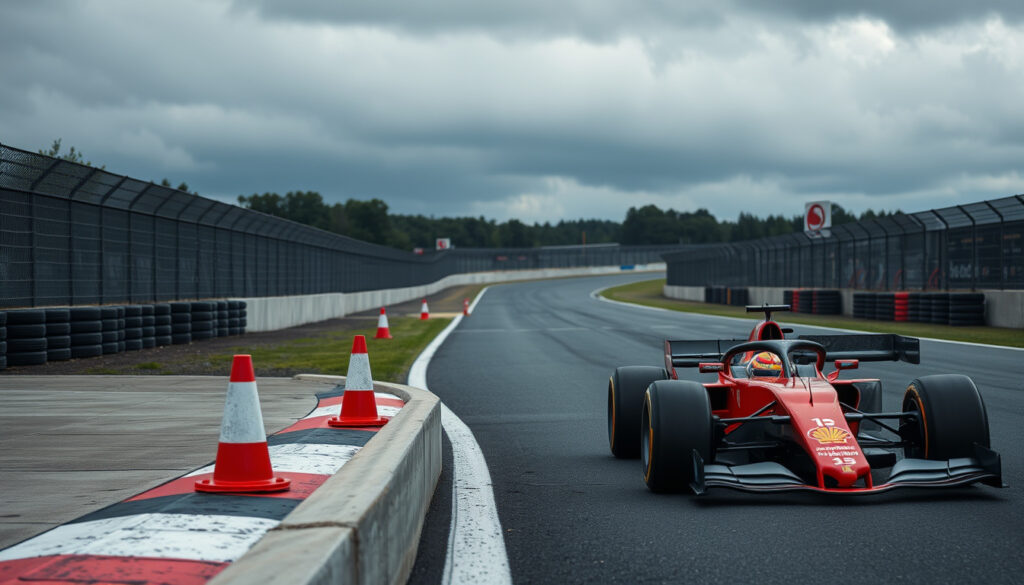
Jules Bianchi – The F1 Driver Who Changed Safety Forever
Who Was Jules Bianchi? Biography and Career
| Full Name | Jules Lucien André Bianchi |
| Born / Died | 3 August 1989 – 17 July 2015 (age 25) |
| F1 Team | Marussia F1 Team (2013–2014) |
| Crash Date | 5 October 2014, Japanese Grand Prix |
- Jules Bianchi was the first Formula 1 driver to die from injuries sustained during a Grand Prix since Ayrton Senna in 1994.
- The crash occurred at Suzuka Circuit under wet conditions, leading to a collision with a recovery vehicle.
- Bianchi suffered a diffuse axonal injury and passed away nine months later.
- His death prompted major safety reforms including the introduction of the Halo cockpit protection device and the Virtual Safety Car (VSC).
- Bianchi was the godfather of current Ferrari driver Charles Leclerc.
- His racing number 17 was retired from Formula 1 as a mark of respect.
| Fact | Value |
|---|---|
| Nationality | French |
| F1 Debut | 2013 Australian Grand Prix |
| F1 Races | 34 |
| Best Finish | 9th (Monaco 2014) |
| Racing Number | 17 |
| Cause of Death | Diffuse axonal injury from crash |
| Legacy | Safety reforms, number retired, Leclerc connection |
What Happened in Jules Bianchi’s Crash at Suzuka?
The Scene at Turn 8
During the rain-affected 2014 Japanese Grand Prix at Suzuka, Adrian Sutil’s Sauber hydroplaned off at Turn 8 and hit a tire barrier. As a recovery crane removed Sutil’s car, Bianchi’s Marussia aquaplaned at the exact same spot on the next lap, colliding with the rear of the crane. The impact ripped the car’s roll hoop off, and Bianchi’s helmet struck the crane’s lead-weighted undersurface, causing massive head deceleration.
The Physics of the Impact
Calculations estimated deceleration peaks exceeding 200 G, far beyond human tolerance. The force caused Bianchi’s brain to shift inside his skull, generating shear forces that tore neural axons. This mechanism is what makes diffuse axonal injury so devastating — it is not a single focal wound but widespread damage across the brain’s white matter.
The collision subjected Bianchi to forces exceeding 200 G, a level that inevitably produces catastrophic neurological injury. The crane’s rear structure was lead-weighted, making it an immovable object relative to the car.
How Did Jules Bianchi Die? Medical Details and Aftermath
Diffuse Axonal Injury Explained
Diffuse axonal injury occurs when the brain moves back and forth within the skull due to acceleration and deceleration, shearing tissues and disrupting neuron communication. Unlike focal injuries, this type of damage is widespread and often leads to brain death due to swelling and brainstem impingement. Physicians describe it as one of the most devastating forms of traumatic brain injury.
Treatment and Outcome
Bianchi underwent emergency surgery for a subdural hematoma but remained in a medically induced coma with irreversible neurological damage until his death in Nice, France, on 17 July 2015. His family and medical team confirmed the cause as diffuse axonal injury, which was the primary injury reported by physicians throughout his treatment.
While the specific autopsy report has not been publicly detailed by the family, medical records and physician statements consistently identified diffuse axonal injury as the cause. The family has chosen to keep full autopsy details private.
What Is the Connection Between Jules Bianchi and Charles Leclerc?
Both Bianchi and Leclerc are from Monaco and were considered rising stars in the motorsport world. Leclerc has frequently honored Bianchi, calling him a “big brother” figure. The relationship was deeply personal: Bianchi was Leclerc’s godfather, and Leclerc has stated in multiple interviews that Bianchi was the reason he pursued a career in Formula 1.
At the 2018 Belgian Grand Prix, Leclerc crashed heavily, and his car’s Halo was damaged. He credited the device — whose implementation was accelerated by Bianchi’s death — with saving his life. The Halo has since been credited with protecting drivers in at least eight known instances.
Leclerc has said Bianchi was his godfather and the reason he is in F1 today. He continues to honor Bianchi at his home race in Monaco, keeping his memory alive in the paddock.
When Did the Key Events in Jules Bianchi’s Story Unfold?
- 3 August 1989 — Birth in Nice, France.
- 2013 — F1 debut with Marussia.
- 5 October 2014 — Crash at Japanese Grand Prix, hitting a recovery vehicle under wet conditions.
- 6 October 2014 — Diagnosed with diffuse axonal injury, placed in induced coma.
- 17 July 2015 — Death at age 25.
- 20 July 2015 — Funeral in Nice.
- 2018 — Halo device becomes mandatory in F1.
- 2024 — 10th anniversary of the crash, renewed safety discussions.
What Is Known and What Remains Unclear About the Crash?
| Established Information | Information That Remains Unclear |
|---|---|
| Jules Bianchi died on 17 July 2015 from injuries sustained in the 5 October 2014 crash. | Exact last words: there are unverified reports but no confirmed quote from official sources. |
| The crash involved a collision with a mobile crane at Suzuka. | Full autopsy details: family has not released the complete report, though medical records show diffuse axonal injury. |
| He was driving for Marussia and used car number 17. | Crash video: some footage exists but is not widely circulated due to sensitivity; the FIA investigation report is available. |
| Charles Leclerc is his godson and considers Bianchi a mentor. | — |
What Was the Broader Context of the Suzuka Crash?
Jules Bianchi’s crash occurred during the 2014 Japanese Grand Prix, which was affected by heavy rain from Typhoon Phanfone. The race was started under safety car conditions. Bianchi lost control on the same corner where Adrian Sutil had spun earlier; double yellow flags were displayed, but Bianchi did not slow enough. The crash highlighted shortcomings in recovery vehicle protocols and driver warning systems. The FIA investigation led to the implementation of the Virtual Safety Car (VSC) and later the Halo device.
Bianchi’s death was a turning point for F1 safety. The Halo device has since saved multiple lives, including Romain Grosjean in 2020 and Zhou Guanyu in 2022. The VSC prevents drivers from maintaining high speeds during incidents. The legacy also includes the “Bianchi Rule” requiring all recovery vehicles to be behind barriers or under strict timing. The emotional connection to Charles Leclerc keeps Bianchi’s memory alive in the paddock.
Bianchi’s tragedy directly forced the FIA to accelerate the Halo project, which was already in development but faced resistance, and led to systemic changes in track safety that continue to protect drivers today. The safety measures inspired by his crash include the mandatory Halo device, the Virtual Safety Car system, and stricter recovery protocols governing when and how recovery vehicles can operate on live tracks.
What Have Officials and Family Said About the Tragedy?
“Jules was a rising star, and his death was a tragedy that shook the entire motorsport world.”
— FIA statement (2015)
“He was my godfather and the reason I am in F1 today.”
— Charles Leclerc (multiple interviews)
“The crash was a wake-up call for the sport. We had to change.”
— Ross Brawn (former F1 technical director)
What Is Jules Bianchi’s Lasting Legacy?
Jules Bianchi is remembered as a rising star who died too young at age 25, and his death is widely regarded as the catalyst for the modern era of F1 safety. The Halo device, Virtual Safety Car, and revised recovery protocols all trace back to the Suzuka crash. As of 2025, the legacy continues with the Jules Bianchi Foundation supporting young drivers and safety initiatives. Charles Leclerc continues to honor Bianchi at his home race in Monaco. The racing number 17 remains retired from Formula 1 as a permanent mark of respect. For more on how sudden loss reverberates through public life, read Bob Saget – Cause of Death, Net Worth and Life Story.
Frequently Asked Questions
What was Jules Bianchi’s age at death?
He was 25 years old. Born on 3 August 1989, he died on 17 July 2015.
What car did Jules Bianchi drive?
He drove for the Marussia F1 Team (later Manor) in 2013 and 2014, piloting the MR02 and MR03 chassis.
What was Jules Bianchi’s number?
His racing number was 17. It has been retired from Formula 1 as a mark of respect.
Was an official autopsy report released?
The full report has not been publicly released by the family. Medical records and physicians confirmed diffuse axonal injury as the cause of death.
Is there a video of Jules Bianchi’s crash?
Some footage exists but is not widely circulated out of respect for the family. The FIA published an official investigation report with detailed analysis.
How did Jules Bianchi’s crash change Formula 1 safety?
It led directly to the mandatory Halo device, the Virtual Safety Car system, and stricter recovery vehicle protocols — all of which remain in use today.
What team did Jules Bianchi drive for?
He drove for the Marussia F1 Team (2013–2014), scoring his best result of 9th at the 2014 Monaco Grand Prix.
Where was Jules Bianchi born?
He was born in Nice, France, on 3 August 1989.
How many F1 races did Jules Bianchi win?
He did not win any Formula 1 races. His best finish was 9th place at the 2014 Monaco Grand Prix.
What injuries did Jules Bianchi sustain?
He sustained a diffuse axonal injury, a severe traumatic brain injury caused by extreme deceleration when his helmet struck the recovery crane.
More related posts
 Maine Coon Cats for Sale – Prices, Breeders and Scam Guide
 Diljit Dosanjh – Biography, Net Worth, Songs and 2026 Tour
 Flu Jab Near Me – Free NHS Locations and Booking Guide
 Sandra Oh – Biography, Age, Husband, and Net Worth
 Scunthorpe United F.C. – National League Status and History
 How Long Can a Doctor Give a Sick Note for UK – Rules Explained
 Which Size of Fibroid Is Dangerous – mm, cm, and NHS Guidelines